
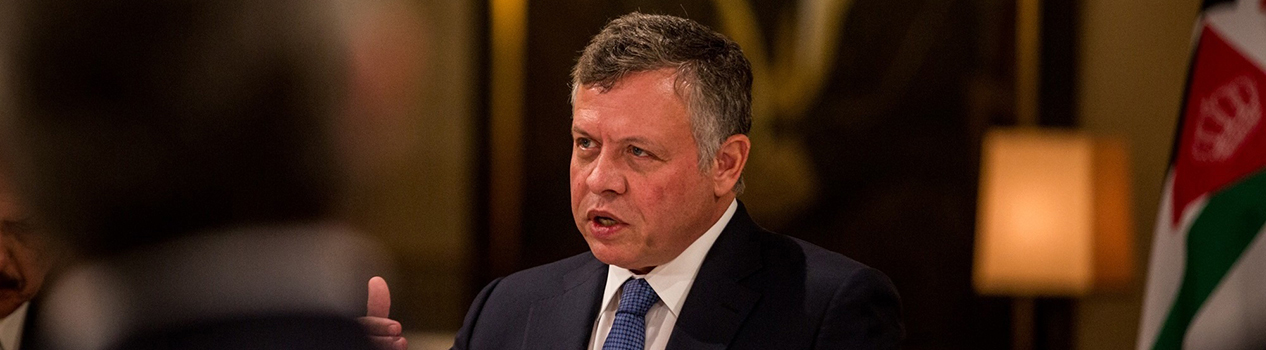
King reviews regional developments with world leaders
© أرشيف الديوان الملكي الهاشمي
© Royal Hashemite Court Archives
His Majesty
King Abdullah on Saturday met with several leaders and senior officials who are participating in the World
Economic Forum on the Middle East.
During a meeting with Iran's Foreign Minister Manouchehr Mottaki, the King said all countries of the region
as well as the international community should be committed to achieving peace.
The King briefed the Iranian official on Jordan's efforts to end sectarian strife in Iraq, reiterating that the
conflict threatens the future of the Muslim nation. The Iraqi political scene should represent the different
Iraqi groups and sects, he said, warning that failure of reconciliation efforts would lead to more violence.
Highlighting the challenges facing the Muslim nation, King Abdullah stressed that leaders should shoulder
their responsibilities.
King Abdullah also expressed his concern about the repercussions of the international crisis concerning
Iran's nuclear program. He said that Jordan believes that the use of force to resolve the crisis would
increase instability in the region. He added that Jordan supports the utilization of nuclear power for
peaceful purposes.
The King emphasized that the conflict over Palestine is the core conflict in the region, and said that the
crisis could only be resolved through a two-state solution.
Mottaki, who conveyed greetings from Iranian President Mahmoud Ahmadinejad, expressed his
appreciation of the King's efforts to maintain stability in the region.
During the World Economic Forum, King Abdullah also received Bahrain's Crown Prince Salman Ben
Hamad Al Khalifa, who conveyed greetings from Bahraini King Sheikh Hamad Ben Isa Al Khalifa.
The two reviewed aspects of bilateral relations and means to strengthen them.
The Bahraini crown prince expressed appreciation of Jordan's efforts to make the forum a success.
Also on Saturday, the King held talks with Afghan President Hamid Karzai, during which they reviewed
regional conditions, the latest developments in Afghanistan and peace-making efforts there.
Stressing Jordan's support for Afghanistan, King Abdullah expressed the country's readiness to provide
scholarships for Afghan students at Jordanian universities.
Karzai thanked the King for Jordan's support to Afghanistan, particularly the humanitarian assistance
Jordan provides through a 60-bed field hospital set up by the Royal Medical Services in Mazar-e-Sharif to
treat Afghans injured in the war.
King Abdullah also met with Iraqi Vice President Tareq Al Hashemi. At the meeting, he expressed
Jordan's concern to see Iraq return to stability and security.
At another meeting with Denmark's Prime Minister Anders Fogh Rasmussen, the two sides reviewed the
latest developments in the Middle East, especially efforts to push forward the peace process and arrive
at a final settlement to the Palestinian-Israeli conflict.
The King and the Danish official reiterated their interest in enhancing bilateral relations and increasing the
volume of commercial trade. Rasmussen indicated that Denmark proposes to open an embassy in
Amman to strengthen cooperation between Denmark and the Kingdom.
King Abdullah also received the Yemeni President Ali Abdullah Saleh's adviser, Abdul Kareem Aryani,
who conveyed the Yemeni president's greetings. Talks between the two sides focused on the latest
regional developments and efforts to revive the peace process.
The King also met on Saturday with several US congressmen, including Brian Baird, Gordon Smith, Orrin
Hatch and Jane Harman, and reviewed developments in the Palestinian territories.
The King urged the congresspersons to support efforts to relaunch negotiations Palestinian-Israeli
peace talks, stressing the importance of the time factor. He said it was imperative to reach a
comprehensive and viable solution to the conflict.
In addition, King Abdullah stressed the Kingdom's full support for political efforts to restore stability in
Iraq.
